
Slab Leaks · February 12, 2026
Why 1970s Fountain Valley Homes Get Slab Leaks
The soil, the hard water, and the thin-wall copper that make slab leaks so common in the city's tract homes, plus how the new smart meters can catch one early.
If you own a home in Fountain Valley built in the 1960s or 1970s, a slab leak is one of the more likely serious plumbing problems you will face. It is not bad luck, and it is not poor maintenance on your part. It is the predictable result of how these homes were built, the water that runs through them, and the ground they sit on. Understanding why makes the problem far less mysterious, and easier to catch early.
What a slab leak actually is
Most Fountain Valley homes are built slab-on-grade: a concrete foundation poured directly on the ground, with the water supply lines running through or beneath that concrete. A slab leak is simply a leak in one of those buried lines. Because the pipe is encased in or under concrete, the water has nowhere obvious to go, so it heats a patch of floor, seeps up through cracks, or quietly runs out to the soil while your bill climbs.
The three forces working against the pipe
Three things combine to make slab leaks common in this specific housing stock, and all three are baked into the homes themselves.
Thin-wall copper
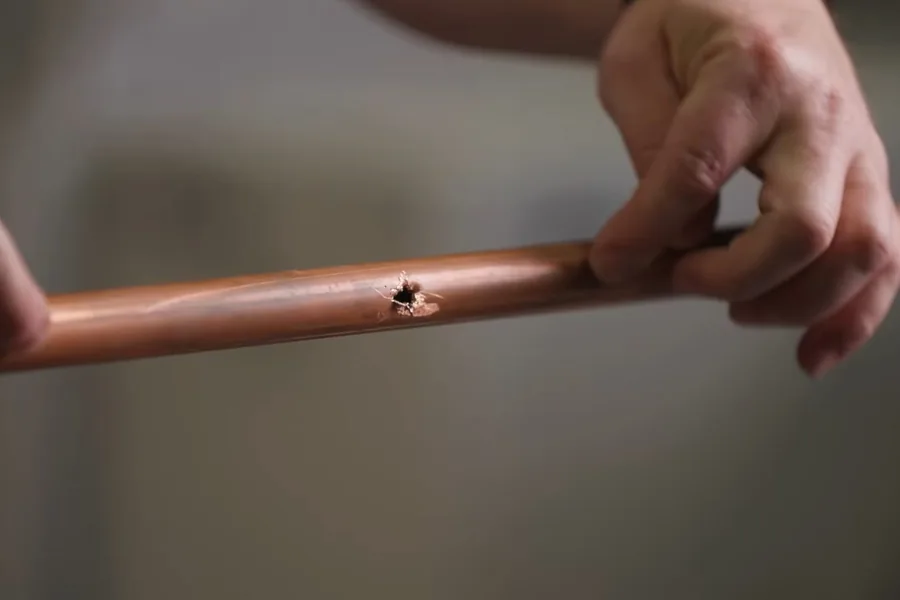
Many Fountain Valley tracts were plumbed with M-type copper, the thinner-walled grade. It was standard and perfectly legal, but a thinner wall has less material to lose before a pinhole forms. After 50-plus years, that margin is gone.
Very hard water from the inside
The city's water is very hard, running well into the teens in grains per gallon. Hard water is mildly corrosive over decades and leaves scale that, combined with the constant flow, slowly thins copper from the inside out.
Old farmland soil from the outside
Much of Fountain Valley and neighboring Garden Grove was dairy farmland before the tracts went up. That soil chemistry can corrode buried copper from the outside, attacking the pipe in the one place you cannot see it.
Why now, and not 20 years ago
Copper does not fail on a schedule, but it does have a service life, and in these conditions that life is roughly half a century. The homes built in the late 1950s through the 1970s have now crossed that threshold together, which is why slab leaks went from rare to routine across the city in recent years. If your neighbors are talking about slab leaks, it is because your whole neighborhood's pipe reached the same age at the same time.
The warning signs
A slab leak rarely announces itself loudly. The signs are quiet, and catching them early is the difference between a targeted repair and a flooded, mold-damaged floor:
A warm spot on the floor
A hot-water line leaking under the slab warms the tile or laminate above it.
A water bill that jumped
Water running 24 hours a day under the slab shows up on the meter, often as a sudden, unexplained increase.
The sound of running water
With the house quiet and everything off, a faint hiss or trickle can mean water is moving where it should not be.
A meter that never stops
Shut off every fixture and watch the water meter. If the dial keeps creeping, water is escaping somewhere.
How smart meters are changing early detection
Here is a genuinely useful local development: the Fountain Valley Water Division has been rolling out advanced metering, the kind of smart meters that record water use continuously. That data can flag the telltale pattern of a slab leak, a steady, around-the-clock flow that never drops to zero even overnight when no one is using water. Some systems can alert you to that anomaly. If your neighborhood has the new meters, watching for a continuous-flow alert or reviewing your usage data online can catch a slab leak weeks before you would otherwise notice it, when the repair is still small.
What to do about it
If you suspect a slab leak, the worst response is to ignore it or to start cutting concrete on a guess. A leak located precisely with acoustic and electronic equipment can often be fixed with a small access cut, an overhead reroute that avoids the slab entirely, or, for a home that has already had multiple leaks, a full repipe that ends the cycle. The right answer depends on the pipe's overall condition, and an honest plumber will lay out the trade-offs rather than defaulting to the most expensive option.
The takeaway: slab leaks in Fountain Valley are predictable, not random, and the homes most affected are now reaching the age where the first leak arrives. Knowing the warning signs, and watching your meter data if you have a smart meter, is the best protection against a small leak becoming an expensive one.